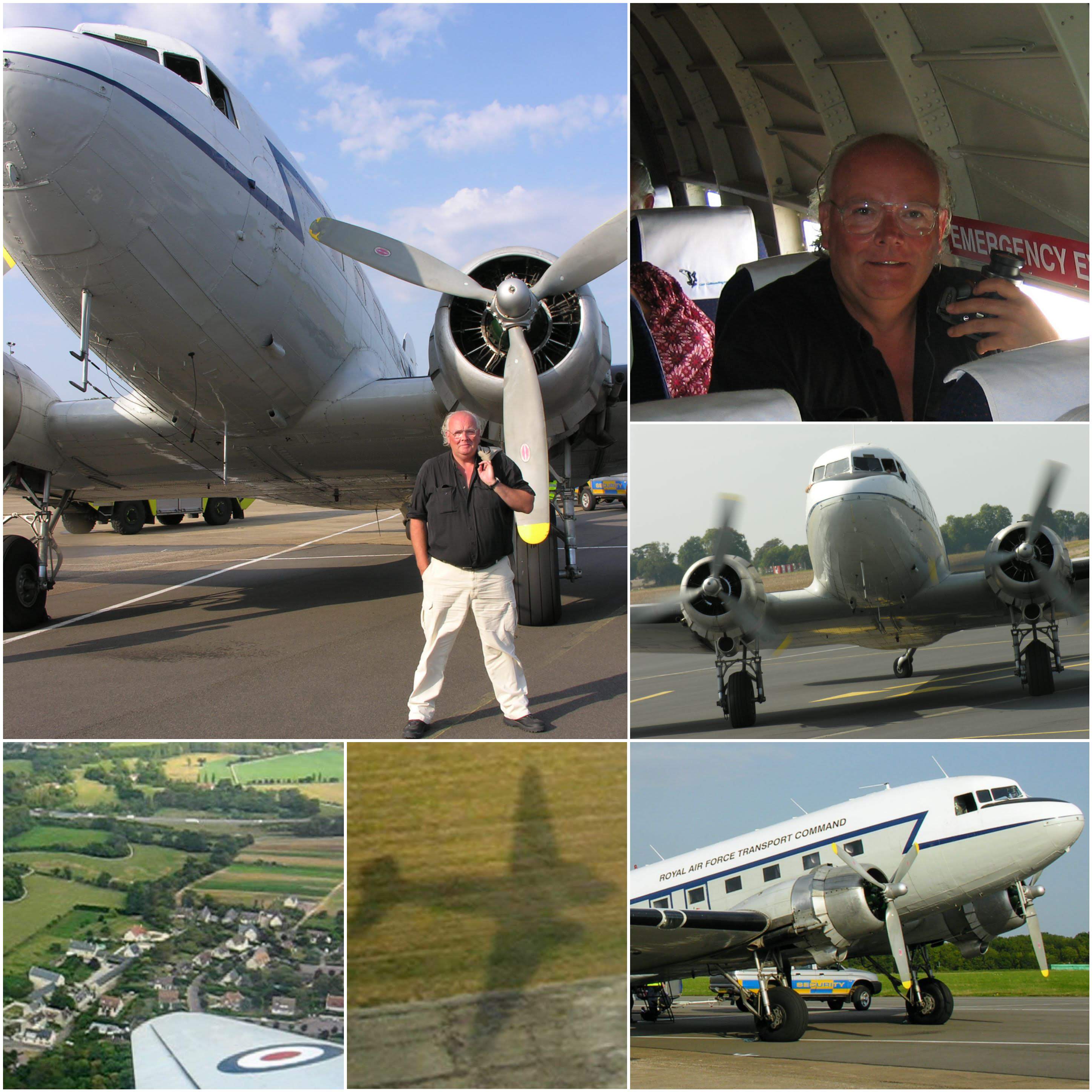
Watching the iconic Dakota transport aircraft airborne for D-Day75 reminded me vividly of the day I had the privilege and pleasure of flying in one.
Our battlefield press travel trip to Normandy ended at Caen-Carpiquet Airport. A modern terminal stood near a concrete bunker, relic of when the airfield was held by the 10th SS Hitler Youth Division who fought to the death against the Canadians in 1944.
Our middle-aged group were like excited schoolboys as we dashed up the steep steps of Dakota G-AMPY, operated by coventry-based Air Atlantique in the colours of RAF Transport Command.
The seats were surprisingly spacious and the fuselage very high. The bare walls were lined with bolts and batons holding the metal skin in place. Despite the airliner seating and holiday atmosphere it wasn’t hard to picture the fuselage pack with paratroopers.
I nabbed a seat by an emergency exit looking over the trailing edge of the port wing. Takeoff was very gentle and we enjoyed the novelty of the floor rising up as the Dakota, a tail dragger, lifted her rear wheel.
G-AMPY crossed the coast east of Arromanches not far from where British airborne troops had captured the Orne river crossings before the beach landings began.
I looked down and saw the artillery bunker I’d photographed earlier near the beach where my father landed in July, 1944.
Normandy is packed with museums and memorials to the largest seaborne invasion ever staged and the savage ten-week battle that followed which saw casualty rates reach WWI levels at times. Now it is a beautiful region of rolling landscapes, open skies, wonderful cheeses.
As the Dakota banked we saw a string of dark beads set in the sparkling water that were the remains of the prefab Mulberry harbour assembled in 1944 to land supplies. Massive sections survive the ravages of the sea and from above they look like the weathered remains of an ancient stone circle.
We headed west, passing Port-en-Bessin where I’d enjoy a very pleasant lunch the day before.
Soon we were over Utah Beach, then Point du Hoc, a small spit of crater-pitted clifftop captured by US troops who scaled the heights using grappling hooks.
Next Omaha. We circled above the American cemetery which looked huge even from altitude with its fields of white stone crosses. Beyond was the Saving Private Ryan beach.
We all snapped away despite the windows speckling our photos with starbursts as the sun caught the scratched Perspex.
All too soon we were heading north over the Channel and homeward at 3,000ft.
The lofty cabin had the atmosphere of a school outing with grizzled journos taking photos of each other and the crew.
Crossed the Sussex coast just east of Brighton for a gentle landing at Biggin Hill where we took more photos of G-AMPY on the tarmac.
A day to remember, following the paths of heroes – BILL TODD
